Programme Quality

The Programme Quality Framework

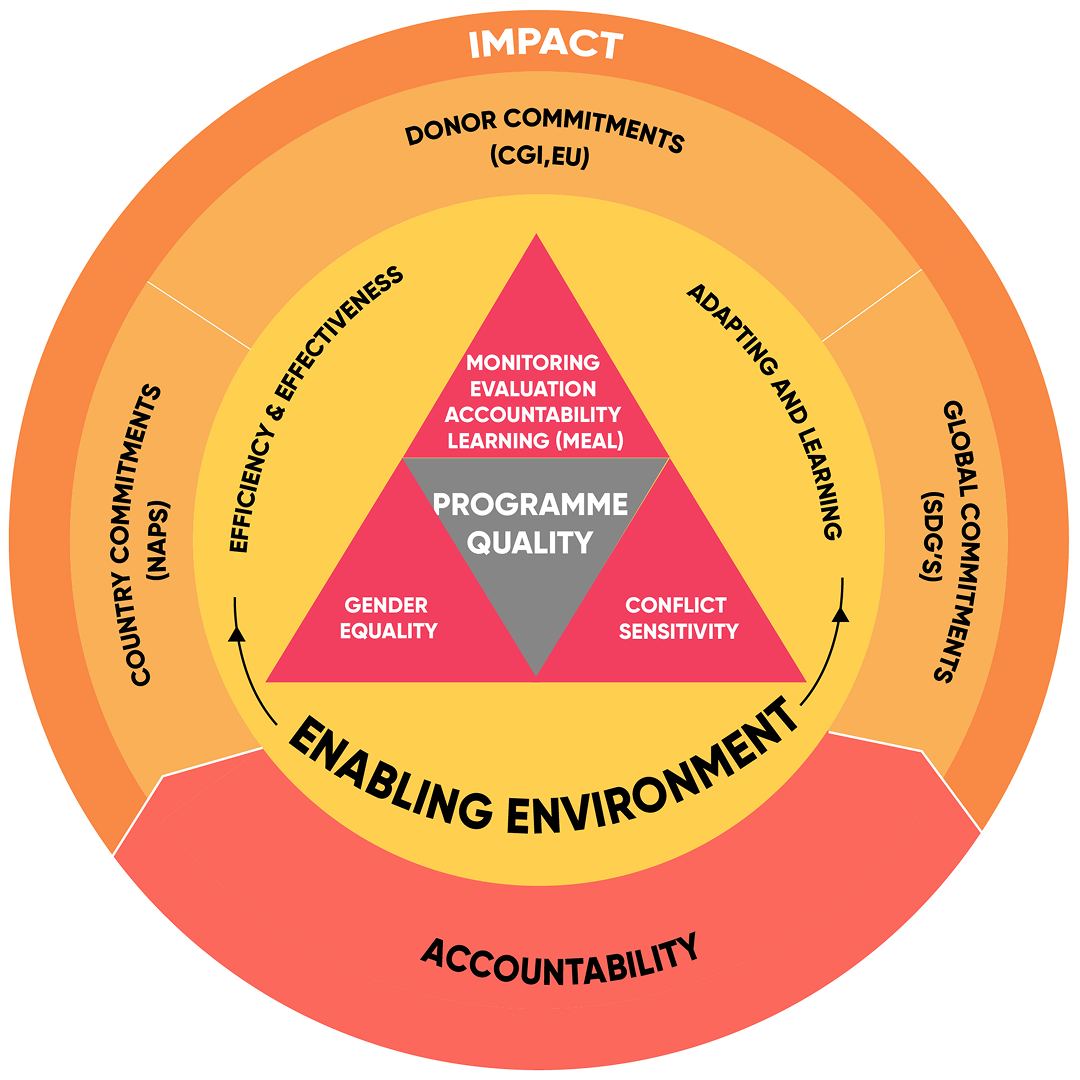
Programme Quality is central to how we operate and is essential to maintaining the highest programming standards. This enables us to be able to deliver fully on the goals and outcomes we have committed to and be accountable. Programme quality helps us create and sustain an organizational culture that upholds these standards collectively, so all our work is able to make real and lasting change in the lives of women, and youth in particular, irrespective of their ethnicity, religion, class, caste or age.
quality section 1 image
  • Gender Transformative Programming – This approach helps us operationalize our commitment to advancing gender equality by integrating strategies and practices that challenge and transform unequal gender power relations and norms in all our work.
  • Conflict Sensitive Programming enables us to understand how our programming and our behaviours interact with the contexts we work in so we can proactively adapt to minimize negative outcomes.
  • Monitoring, Evaluation, Accountability and Learning (MEAL) helps to ensure programme quality by helping us be effective, transparent, accountable, and to continuously learn, adapt and improve.
  • Accountability focuses on demonstrating how we hold ourselves accountable and how we enable those we work with (i.e., project participants, staff, partners, donors, other stakeholders) to hold us responsible.
  • Impact is the transformational change we seek to make through our programming. We will show how we have contributed to effecting such change by providing evidence and learning – at the project, intervention and organizational level.
  • We form Partnerships to engage the complementary strengths of different actors, to be able to collaborate on specific objectives, challenges and opportunities in ways that achieve greater impact than we could have achieved alone.

The combined application of our programme quality standards helps us,

  • Apply the principles of do no harm, non-discrimination, inclusive participation and transparency in our programming, and in how we operate, build and maintain relationships with project participants, partners and other stakeholders.
  • Ensure the safety and dignity of those we work with and those who work for us.
  • Demonstrate our accountability to project participants, donors, stakeholders, staff and partners
  • Increase the efficiency and the effectiveness of initiatives, operational models and programme functions
  • Generate knowledge and learning to enhance our own effectiveness, and accountabilities, promote innovation and scaling of successful models or approaches
quality section 2 image
quality section 3 image

Gender Equality

At Chrysalis, we recognize that if we are to achieve our programme goals and outcomes, and advance gender equality we must,

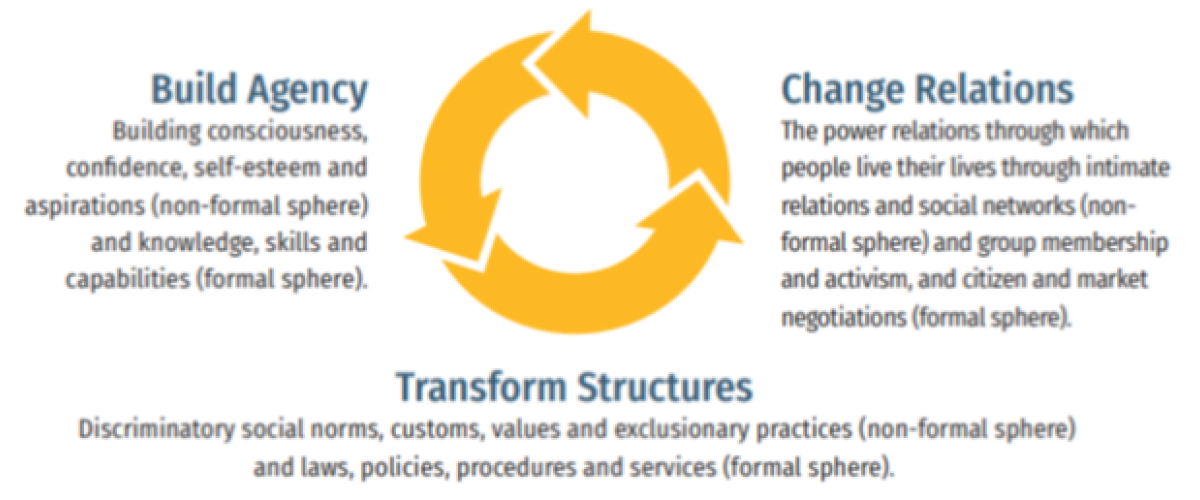
Work with individuals to raise the consciousness, self-esteem, confidence, and aspirations to change their world and the knowledge, skills, and capabilities to do so.

Change is more likely to stick if the people around us support it as we work to address the inequality in intimate relations, family, social and political networks, marketplaces, and community or citizen groups.

Discrimination and exclusion can be perpetuated through laws and policies as well as social norms and customs that affect how people of different genders are expected to behave and participate in social, economic and political spheres. Advocacy against discriminatory laws and for new laws and policies to reduce discrimination and work with communities and power holders is necessary to critically reflect on and transform the norms and practices that perpetuate injustice.

quality section 4 image

CARE’s Gender Equality Framework (CARE, 2023)

Not only will we use this framework to conceptualise and structure our programming – goals, interventions and outcomes – it will also help us frame our analysis during design and in the evaluation of outcomes and impacts and in structuring our learning and knowledge generation.

Conflict Sensitivity

At Chrysalis, we implement diverse programmes, in diverse contexts with diverse groups. Our projects will operate in settings where conflict may not be obvious, but resources are scarce or not distributed fairly and where some groups have more power and privileges than others. In such settings, our efforts to change deeply embedded social norms and relations can be seen as threatening to those who derive power and privileges from the status quo, increasing the likelihood of backlash, reluctance to participate or undermining of project activities.

Further in times of crisis when basic needs such as shelter, food and safe spaces are particularly scarce, the assistance we provide could fuel competition, distort markets and increase the vulnerability of those groups who already have little power to access such resources or legitimize groups who are responsible for rights violations or abuses.

Conflict sensitivity approaches and tools help us assess our interactions in a given context (i.e., programming and our action as those implementing a project). So that we are able to adapt and alter our actions to reduce our more harmful interactions and build on the more positive ones. In other words, conflict sensitivity not only helps us be more accountable and responsible for our actions, it helps us do so by being more effective, strategic and responsive in a particular context.

quality section 5 image
quality section 6 image

Monitoring, Evaluation, Accountability and Learning (MEAL)

MEAL provides a structured approach to managing programmes through evidence, accountability and ongoing learning,

Monitoring and Evaluation (M&E) focuses on monitoring programme activities and outputs against predetermined indicators and objectives and on evaluating programme effectiveness using evidence to inform programme decision-making. It provides the data needed to identify programme strengths and weaknesses, make adjustments and report results to stakeholders.

Monitoring, Evaluation, Accountability and Learning (MEAL) on the other hand expands on M&E by including accountability and learning. It does so by ensuring transparency and stakeholder participation in decision-making, facilitating continuous learning and improvement programmes in design and implementation. MEAL provides a more comprehensive, structured and systematic approach to programme management by including accountability and learning in M&E processes.

Chrysalis uses both MEAL and M&E to ensure programme quality. MEAL provides us with a framework for monitoring and evaluating project performance whilst M&E provides the data and evidence to inform programme decision-making. Together, these help us be more effective, transparent and accountable while helping us to continuously learn to improve and adapt.