Projects

2024 - 2026

Ongoing

Multi-Actor Partnership for Pro-Poor and Gender-Equitable Climate Risk Financing in the Context of the IGP’s 2025 Vision

The Multi-Actor Partnership for Pro-Poor and Gender-Equitable Climate Risk Financing in the Context of the IGP’s 2025 Vision project seeks to advance inclusive and equitable climate risk financing in Sri Lanka by fostering collaboration among government institutions, private sector actors, financial service providers, and civil society. In the face of increasing climate-related shocks—including floods, droughts, and extreme weather events—the project recognises that women and marginalised communities are disproportionately affected due to limited access to resources, information, and financial protection mechanisms. It therefore prioritises ensuring that climate financing systems are accessible, affordable, and responsive to the needs of those most at risk.

Aligned with the Insurance Growth Plan (IGP) 2025 Vision, the project supports the design, development, and uptake of inclusive risk financing solutions, including insurance products and broader financial protection mechanisms tailored to low-income and underserved populations. It promotes the integration of gender and equity considerations into national and sectoral frameworks, while strengthening coordination between key stakeholders to create a more enabling environment for inclusive climate finance.

Implemented by Chrysalis with support from CARE Deutschland-Luxemburg and BMZ, the project adopts a systems-strengthening approach that bridges policy, institutions, and communities. It generates evidence on climate vulnerabilities, builds the capacity of financial and insurance actors to develop gender-responsive products, and amplifies community voices—particularly those of women—to influence decision-making processes. Through these efforts, the project contributes to strengthening disaster risk governance and enhancing financial resilience at both community and institutional levels, ultimately supporting a more inclusive, adaptive, and resilient financial ecosystem in Sri Lanka.

Pillars


Climate Justice
Climate Justice

project implementation image

Implementation

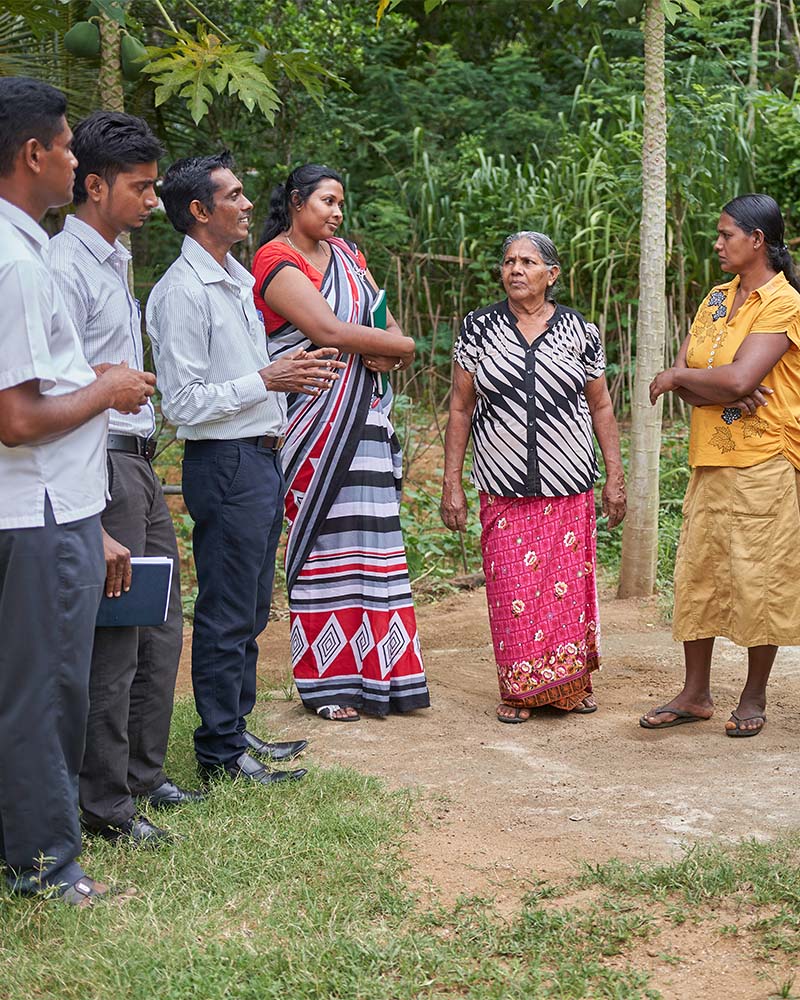
The project adopts a multi-actor, systems-based approach to strengthen climate risk financing mechanisms that are inclusive and gender-responsive. It facilitates collaboration between government agencies, insurance providers, financial institutions, and civil society to co-create solutions that address the needs of vulnerable communities.

Key interventions include supporting policy dialogue and advocacy to integrate gender and equity considerations into climate risk financing frameworks, strengthening the capacity of financial and insurance actors to design inclusive products, and promoting community awareness and access to risk financing tools. The project also works to generate evidence on climate risks and vulnerabilities, particularly among women and marginalised groups, to inform decision-making and improve the design of financial protection mechanisms.

By bridging the gap between communities and financial systems, the project ensures that climate risk financing is not only technically sound but also socially inclusive and accessible.

Beneficiaries

The project primarily benefits low-income and climate-vulnerable communities, with a strong focus on women, smallholder farmers, informal workers, and marginalized groups who are disproportionately affected by climate risks and have limited access to financial protection mechanisms.
It also engages financial institutions, insurance providers, government agencies, and civil society organisations, strengthening their capacity to design and deliver inclusive climate risk financing solutions. By improving systems and institutions, the project generates broader indirect benefits for communities across Sri Lanka.

Participant Testimonial
"When Cyclone Dithwa struck, the seven-day blackout didn't just spoil my milk, yoghurt, and curd—it paralysed my entire livelihood. Standing amidst the losses, I felt truly disheartened, especially as traditional support vanished when I needed it most. While others saw a business in decline, the CRRF saw an opportunity for recovery. Within just three days, a loan of LKR 100,000 via the Matale Business Consortium reached me. That bridge, combined with my own savings, allowed me to secure essential packaging and breathe life back into my production. CRRF didn’t just provide capital; they restored my belief that a disaster doesn't have to be the end of the story."
Mr. Nandana Ranasinghe – Owner: Sunray Dairy Products – Matale

"The CRRF (CDRFI) is a strong example of innovative climate financing, inclusively designed and launched in advance with a clear forecast of future risks. By engaging the SME consortium early, this mechanism enables businesses to restart quickly during crisis situations without delay, by ensuring timely access to CRRF loans. This forward-looking approach strengthens resilience at the local level. We are keen to further understand, after six months of implementation, how SMEs have benefited in practice."
Mrs. F. R. M. Riyaldeen, Additional Secretary, Matale District Secretariat

Operating across Nuwara Eliya and Ramboda, my business depends entirely on accessible trade routes. When landslides and rockfalls severed the roads after Cyclone Dithwa, my supply chain collapsed. I was left with piling surplus stock I couldn't move and damaged inventory I couldn't sell. Even worse, I couldn't collect outstanding payments from vendors who were also struggling. My working capital vanished, and production ground to a halt. In this moment of total stagnation, CRRF became my lifeline. Within seven days, the SME consortium provided the capital I needed to source raw materials. This timely intervention transformed a moment of total collapse into a steady, step-by-step journey toward recovery."
Ms. Manoja Prasanthi – Owner, Little Farm Mushroom – Badulla


Key Outcomes

    The project contributes to strengthening an inclusive climate risk financing ecosystem in Sri Lanka through:
  • Increased integration of gender and pro-poor perspectives in climate risk financing policies and frameworks
  • Improved collaboration between government, private sector, and civil society actors in designing inclusive financial solutions
  • Enhanced capacity of financial and insurance institutions to develop and deliver accessible and responsive risk financing products
  • Increased awareness and uptake of climate risk financing mechanisms among vulnerable communities
  • Strengthened evidence base to inform equitable climate finance and risk management strategies

These outcomes support greater financial resilience and reduce vulnerability to climate shocks among underserved populations.


Data & Impact

Quantitative Results

  • Established four Climate Resilience Revolving Funds (CRRFs) in disaster-vulnerable districts under the CDRFI framework, disbursing LKR 6 million to SME consortia to enable rapid post-disaster financing, strengthen climate resilience, and ensure business continuity for vulnerable MSMEs.
  • 31 SMEs, 19 women-led and 12 men-led, received LKR 3.1 million in CDRFI loans within 10 days, enabling rapid post-Dithwah cyclone recovery, safeguarding, and ensuring quick business restart.
  • For 9 out of 10 SMEs directly affected by the Dithwah Cyclone, the CRRF was the only viable financing option, delivering critical support to rebuild businesses quickly when traditional financial sources were unavailable.
  • Established 4 district-specific MAPs (Multi-Actor Partnerships) with key stakeholders to secure government support, drive inclusive policy reforms, and ensure long-term sustainability of climate risk financing for MSMEs.
  • 4 CDRFI Capacity-Building Trainings Conducted – Strengthened awareness among 115 Multi-Actor Partnership (MAP) members, including 58 women and 57 men entrepreneurs, enhancing knowledge on climate risk financing and insurance.
  • 4 District Climate Resilience Roadmaps Developed – Designed to address climate-related risks affecting SMEs, with active engagement of 72 SME consortium board members (33 women, 39 men), ensuring inclusive resilience planning.
  • 92 MAP Officials Engaged in Roadmap Development – Strengthening district-level coordination and institutional ownership of CDRFI strategies.o
  • CRRF Operational Manual Developed & Institutionalised – Created a practical governance guide for SME consortia to manage CDRFI loans, supported by targeted training sessions with 13 key MAP actors and 36 SME consortium committee members, promoting transparent and sustainable fund management.

Quantitative Results

  • 158 total SME members, 75 (47%) are women-led enterprises participating in the 4 district SME consortia, fostering gender-inclusive business structures and decision-making.
  • Four credit committees now manage the CRRF independently, with 25 SMEs, 60% women-led, in leadership and decision-making roles.


partner icon

Supporting Donors & Partners

The project is funded by the BMZ – the Federal Ministry for Economic Cooperation and Development (Germany), led by CARE Germany and implemented by Chrysalis in collaboration with a range of public and private sector partners, including government institutions, financial service providers, and insurance sector stakeholders, such as Ministry of Industry and Entrepreneurship Development, Ministry of Climate/Environment, Central Bank of Sri Lanka, financial institutions, and insurance companies. and district and divisional secretariats.
It aligns with and contributes to the Insurance Growth Plan (IGP) 2025 Vision, working closely with relevant national-level actors to strengthen climate risk financing systems.