Sureka Madushani, a 39-year-old single mother
of two, has faced numerous challenges in her journey to achieving independence
and success. Separated from her husband and now living in Mundel, her passion
for sewing proved to be a way to support her family and rebuild her life.
After completing her studies, Sureka worked in
a garment factory. She married with a plan to go abroad with his husband – they
dreamed they could save enough money to build a home together. Unfortunately her
husband was unable to secure a visa. Sureka seized the opportunity to go to
Jordan on a three-year contract, with her sister-in-law.
Life in the garment factory in Jordan proved
to be extremely challenging for Sureka. The working conditions were harsh, and
the promised salary was not paid, leading to significant financial strain. Sureka
worked long hours under physically demanding circumstances, often in an unsafe
environment. Meals were rationed, and she was allowed very few personal items, which
drastically affected her health and morale.
Adding to her struggles, Sureka had to manage
the responsibility of caring for her sister-in-law, who fell ill frequently.
This added emotional and financial burden made it difficult for her to focus on
her work. When her sister-in-law was allowed to return to Sri Lanka, Sureka
faced further hardship, as she had to cover the costs associated with her sister-in-law's
return, which drained her already limited resources. The psychological toll of
isolation, combined with the physical exhaustion and stress of the environment,
made her time in Jordan a period of deep struggle and uncertainty.
Returning to Sri Lanka after three years, Sureka
faced a devastating personal blow: all the money she had diligently sent home
to her husband was gone, and he had left her for another woman. With no savings
and her dreams shattered, she struggled to find her footing again, once more in
a garment factory. During this vulnerable period, she had an affair with a man
who offered her support during this difficult time, resulting in another
pregnancy. He pressured her to terminate
this pregnancy, but Sureka refused, choosing to embrace motherhood despite the
immense challenges she faced.
Needing to make ends meet, Sureka chose to
invest in her passion for sewing. Taking classes under a renowned fashion
designer in Puttalam, she learned essential skills and techniques that she
could apply in her business. Eventually, she joined a local garment factory,
where she saved diligently and purchased a sewing machine and an over-lock
machine, laying the foundation for her entrepreneurial venture.
Sureka 's business saw a transformative change
when she received a cash grant of 20,000 rupees from Chrysalis. This support
enabled her to buy essential sewing accessories in bulk from the city, a
practice she had previously deemed unattainable. "I always bought zippers,
thread, buttons, and elastic from the village retail shop," Sureka
explained. "I didn’t have the capital to buy in bulk
from the city. I didn't even want to think
about how much more expensive it was, as there was simply no other
option."
Before receiving the Buddhist Global Relief (BGR)
multipurpose cash grant, Sureka spent 9,000 rupees each month on zippers,
buying them at 30 rupees a piece from the local village shop. The grant allowed
her to purchase zippers from the city for only 12 rupees each, significantly
reducing her monthly zipper expenses to 3,600 rupees and generating a profit of
5,400 rupees. Furthermore, she realized savings of 2,000 rupees on gold
zippers, 2,000 rupees on 30 embroidery yards purchased from the city, and 4,300
rupees on button packets, elastics, and eyelets. She also saved approximately
8,000 rupees on threads and 1,600 rupees on clothes. Sureka's total direct
profit increased to approximately 24,000 rupees per month due to the benefits
of bulk purchasing.
The impact of the funding injection by
Buddhist Global Relief (BGR) has been profound. “When all hope was gone and I
was highly demotivated after the betrayal and hardship I’d endured, this
project gave me much more than just motivation and confidence to achieve what I
have so far," she gratefully acknowledged. "I always wanted to buy
all the little things I need to sew from the village shop like zippers, gold
zippers, balls of thread, buttons, elastic eyelets, smoke threads, etc. but I
never had a lot of money to spare," she recounts.
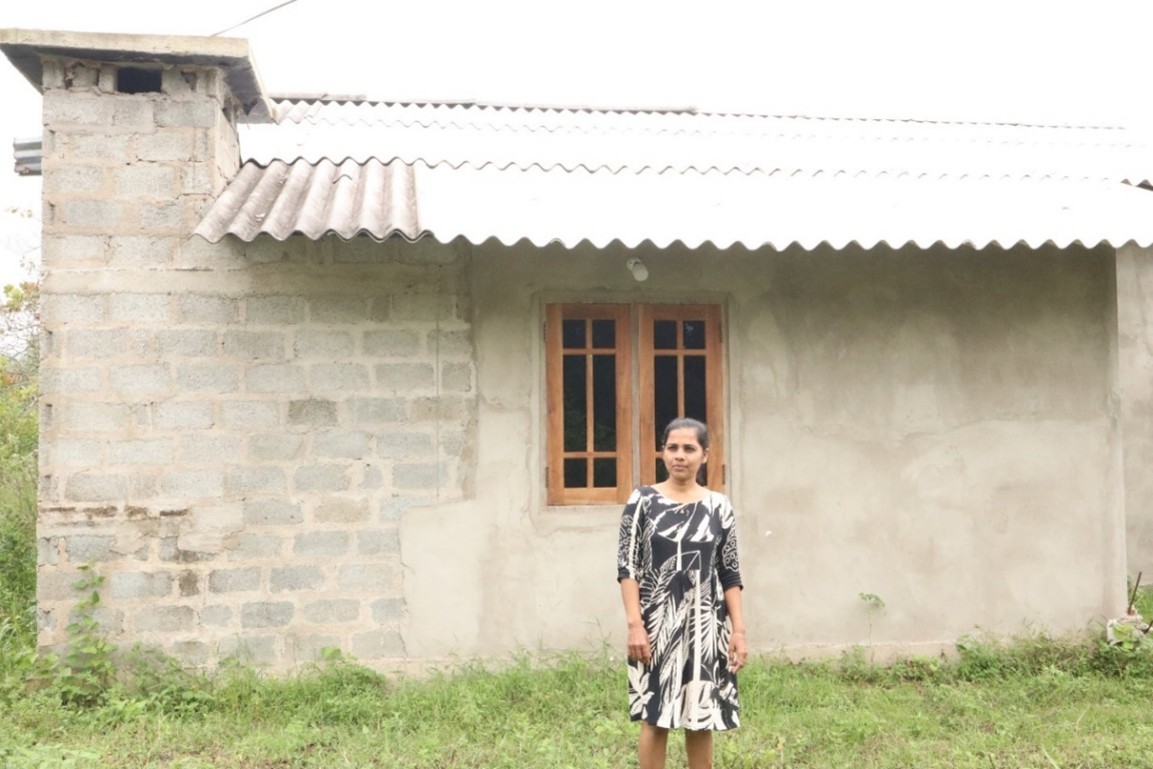
Now
operating her sewing business from her parent's home, she is saving every cent
possible to achieve her goal. For the past six years, she has been steadily
building her house, reinvesting all profits from her sewing business into the
construction. With her parents helping out to cover other expenses, Sureka can
finally pursue her dream.
Sureka believes that her skills and business
will continue to grow, allowing her to move into her new house soon and further
enhance her operations. While grateful for her family's support, she is
determined to achieve complete independence through her business.
Sureka Madushani’s journey is a compelling
example of how strategic support, combined with personal determination, can
lead to transformative outcomes. Her ability to overcome adversity, including
financial loss and personal betrayal, coupled with the timely assistance from
Chrysalis, has not only improved her financial stability but also reignited her
entrepreneurial spirit. This story highlights the effectiveness of targeted
financial support in empowering women and fostering sustainable economic growth
in local communities. It showcases how one well-placed grant can double in
value in a single year, exemplifying the project's resounding success, and
demonstrating the profound impact of empowering women to rebuild their lives
after facing immense challenges.